

The French language has a reputation for being complicated, and the day le subjonctif (the subjunctive) enters the chat, you might start to think that reputation is earned.
Here’s the thing I keep coming back to after years of teaching and learning languages.
You don’t learn a language by memorizing vocab and rules. You learn it by living inside it until your brain stops translating and starts recognizing.
It’s why you pick up key phrases so easily when you travel, just from hearing them again and again. Some of what follows will be useful if you’re brand new to French. Some of it is just as relevant if you’ve been at this a while and want to go deeper. And some of it is fun enough that you won’t even feel like you’re studying.

Not everyone can move to a remote town in the South of France for a year to learn French. What you can do is build an environment where you’re surrounded by French on purpose, every day.
When you’re constantly hearing, reading, and speaking French, even badly, you trigger something researchers call implicit learning. Your brain starts noticing patterns on its own: how words tend to be spelled, how sentences tend to be built, how a phrase is supposed to sound before anyone’s taught you the rule for it.
Do that consistently, and those patterns start to become automatic. That’s l’automatisme (automaticity), the point where you’re no longer translating in your head, you’re just understanding. Once that happens, your energy gets freed up for the parts that actually take real thought: forming your own sentences, saying something specific, holding an actual conversation.
That’s the goal. Everything below is really just different ways of feeding your brain more French, more consistently, so it can start doing that work for you.
1. Know your why before picking your method
Are you learning French because you want to move there eventually? Because you're planning a trip and want to actually understand what's happening around you? Or because you’re amoureux·se (in love) with all things French (or have a French lover!)? Or for no particular reasons other than trying something new? Your answer changes what "immersion" should look like for you, and how deep you go can fluctuate throughout each stage of learning.
If you're just starting, your why will point you toward a method: structured classes if you want real accountability, podcasts and social media if you'd rather ease in slowly, an app if you just want to start recognizing words. There's no single right entry point.
If you've been learning for months or years, this is worth a second look too. Maybe you started with an app because it felt low-stakes, but you've hit a wall an app can't get you past. Maybe you've been taking classes but haven't built any habits outside of them. The method that got you started isn't always the one that gets you to the next level, and immersion works best when it's actually built around what you're trying to do and feel with the language, not just how you began.
If what you're missing is real accountability and feedback rather than more content to consume on your own, that's exactly what our Online Group Classes are built for.

2. Watch and listen in French every day
This is the easiest way to add immersion to a day that's already full, and it's the one I'd prioritize if you only do one thing on this list.
MOVIES & TV SHOWS
Start with what you watch. Dix Pour Cent (Call My Agent!) is a great entry point: a fast-paced workplace comedy set inside a Paris talent agency, with real French celebrities playing exaggerated versions of themselves (Monica Bellucci, Jean Dujardin, and Charlotte Gainsbourg all show up), so you get a crash course in who our stars actually are. For a film, Intouchables is a modern classic about an unlikely friendship that crosses class lines, and it holds up on a rewatch. Watch with subtitles in your own language first if you need to, then switch to French subtitles once you're steadier, and eventually try without any at all. You'll be surprised how much starts landing. Check my Best French Movie & TV Show to Stream Now blog post for recs of what to watch. Also, the website JustWatch.com is worth checking to see what's available where you are.
 |
 |
 |
MUSIC
Music does something subtitles can't: it gets French into your ear on repeat, without you having to sit down and "study." French Chill Vibes is great for starting your day, getting ready to go out, or having on in the background when you invite people over. If you want to romanticize your life, slow down, and feel like you're in an old French film, try French Oldies (great for cooking, btw).
If you listen to French music on Spotify, turn on lyric translations. You’ll be reading the lyrics in French while you listen, an easy way to turn your playlist into practice. Explore my most listened-to Spotify playlists below:
 |
 |
 |
SOCIAL MEDIA
A few accounts worth following on social media if you want your ear used to how fast French actually sounds:
🧘 Wellness & poetry → @grossomodo._, @wellnessbyjade, @therapieducorps.fr, @philgood___
🎭 Humor → @elodie.arnould, @paulmirabel, @dianesegard
🥐 Food → @lefooding, @leguideultime, @lesparisdelaura, @jaifaim.
✨ Paris → @centrelgbtparisidf, @paris_maville, @mylittleparis
🗞 Media & news → @lemondefr, @french.morning, @period.studio, @konbini, @diversification.media
🎵 Music → @fip, @radiofrance, @durevie
🍿 Cinema → @myfrenchstories, @lostinfrenchlation, @la.machine.infernale, @cinemas_independants_parisiens
3. Read something in French, even slowly
If you are a true beginner, maybe les livres (books) feel intimidating to you, but I think it’s good to have the aspirational goal of a story you can go back to and understand more each time you read it. Le Petit Prince is a short classic that you can find anywhere books are sold, but here are other classics that have been adapted to A1-A2 (beginner) levels:
- La Reine Margot - Alexandre Dumas (A1 - Beginner)
- Les Misérables - Victor Hugo (A2 - Advanced Beginner)
- Le Comte de Monte Cristo - Alexandre Dumas (A2 - Advanced Beginner)
I also often recommend the bilingual books of France Dubin for beginners and advanced beginners. And remember, the point isn't to finish a book in French quickly. It's to have something you return to and let the pattern recognition do its work, made visible on the page in a way it isn't when you're just listening.
4. Put pen to paper
Start with a notebook you'll actually want to use. It doesn't need to be fancy: a simple cahier (notebook) with a sturdy cover you like the feel of is enough. This is where you take notes from classes, work through grammar, or just write words out by hand to build a feel for l'orthographe et la grammaire (spelling and grammar). Writing shifts you from passive recognition to active production, and writing in a notebook instead of typing on a computer helps you slow down and really pay attention to the words you’re putting to paper. You’ll start to notice how they’re written, which accent goes where, where to use an apostrophe, and which words typically have a trait d’union (hyphen), among other spelling curiosities.
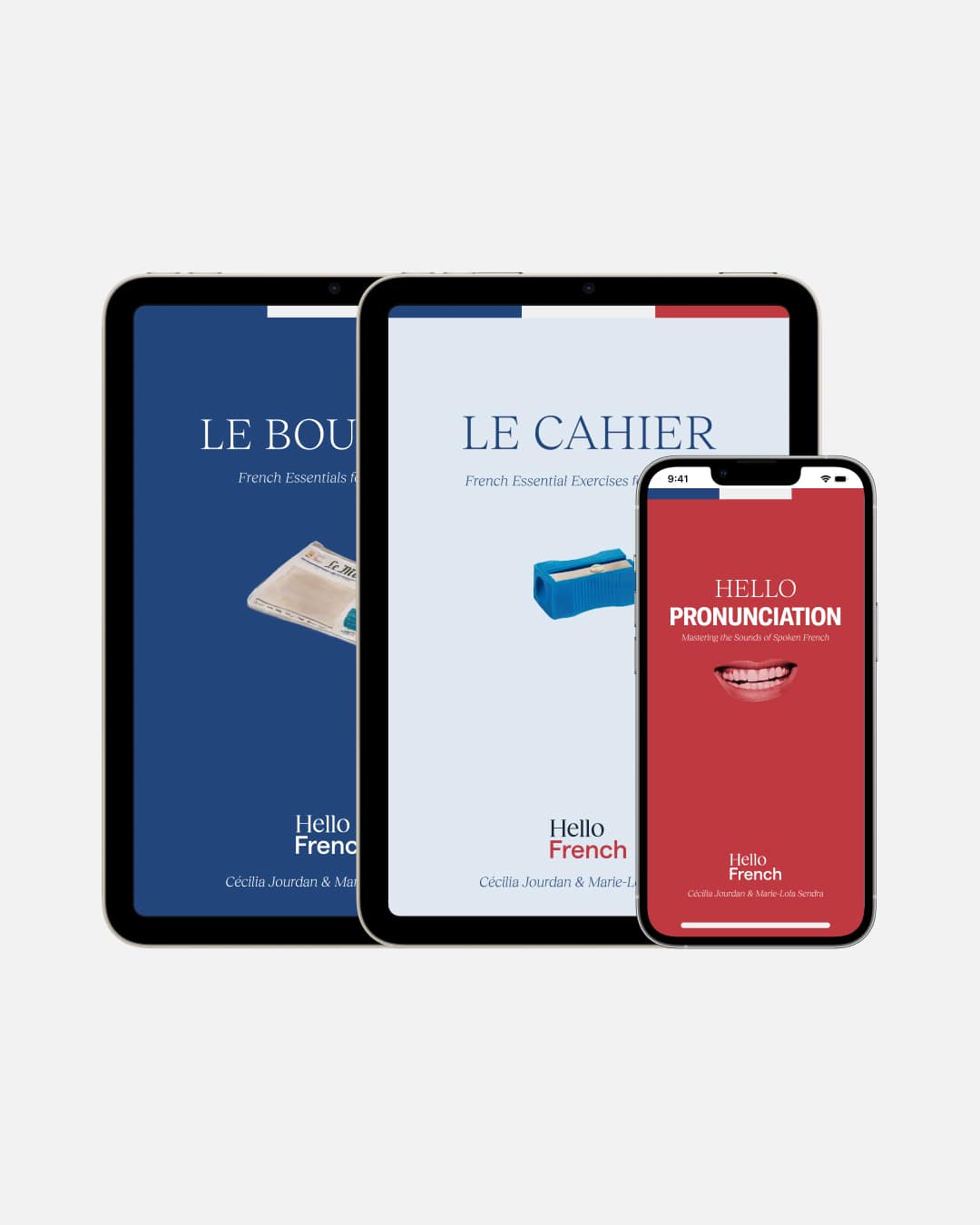
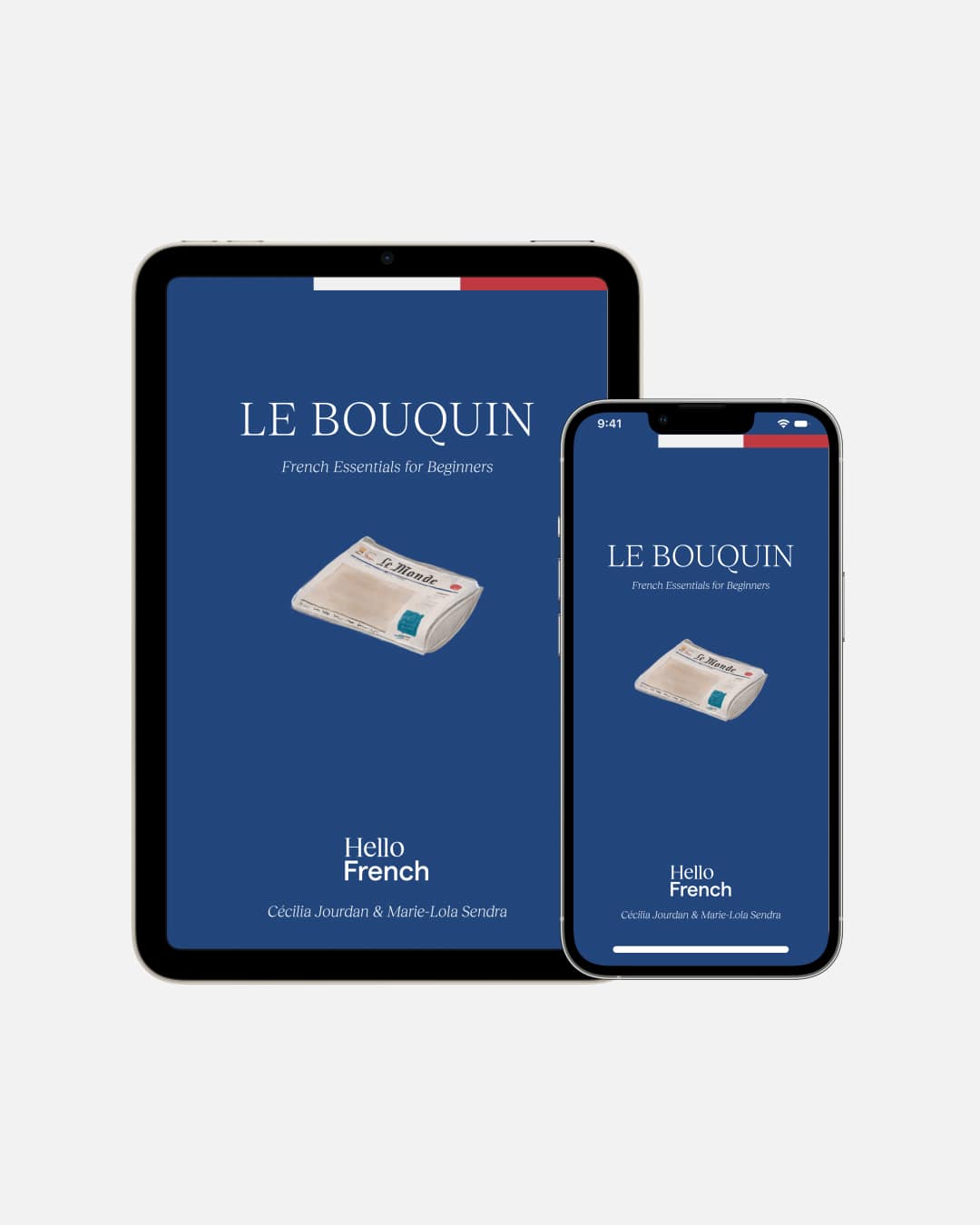
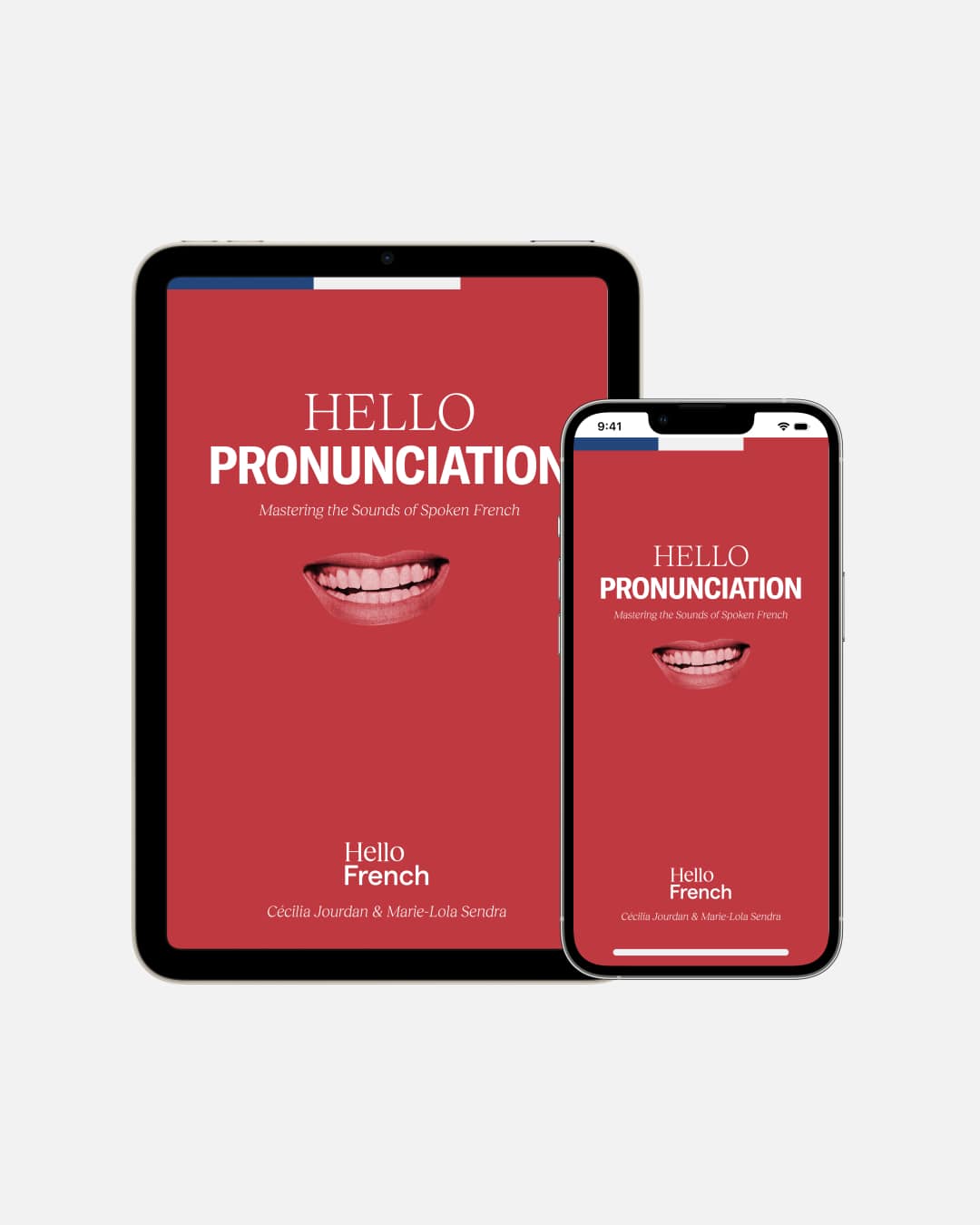
If you’d rather work through all of this on your own than pick up a pen and improvise, the Beginner Bundle has been my bestselling digital bundle for years, and thousands of beginners have used it to learn on their own. It pairs Le Bouquin, the essentials, with Le Cahier, the exercise companion this whole section is really about, and Hello Pronunciation, so the writing, the grammar, and the sounds of the language are covered in one place.

5. Surround yourself with French things
Build a small French corner in your home. The notebook above is a good place to start, then let the rest follow. A French Poster on the wall you actually look at each morning. A map of French wine regions by the door. A bouquet of lavender on the table (because half of what makes a corner feel French is the smell of it!)
IN THE BATHROOM - la salle de bain
Swap your everyday soap for a bar of savon de Marseille and notice how much longer the ritual of washing your hands takes when you actually like doing it. A nice candle lit while you get ready. A French beauty product added to your morning routine (read the ingredients list in French for pronunciation practice).
IN THE KITCHEN - la cuisine
A Staub, the kind you’d use for a real boeuf bourguignon (a beef stew you let cook all afternoon). A set of knives you enjoy holding. An oyster platter you pull out the one night a month you decide to make an occasion of dinner.
The options are endless. And every time you use one of these, it’s a small return to why you decided to learn cette belle langue in the first place.
6. Cook your way into French
Food (la nourriture) is an underrated immersion tool, mostly because it doesn't feel like studying at all. An impromptu apéro with friends with an array of French cheeses or a simple roast chicken on Sunday might just do the trick. Crêpes are my go-to for a sweet treat that’s easy to whip up, as well as nice, thick hot chocolate for the colder months.
I know that the French classics are typically very complicated dishes that take hours to make, but the truth is, French people love eating simple foods: a roasted meat + veggies + potatoes est une valeur sûre (is a proven winner). If you’re not sure what to make, any of these cookbooks have delicious, easy, seasonal recipes that will certainly inspire you.
 |
 |
 |
7. Practice a little, every day
Immersion works because it happens every day. Fifteen focused minutes a day (active listening, a handful of new words, a few verb conjugations) will move you further than an occasional long session, because it's the daily repetition that lets your brain keep building on the patterns it's already noticed.
A few ways to build that habit: use flashcards for vocabulary you keep forgetting, learn the lyrics to a song from one of our playlists, or add a few sentences in French to a journaling practice you already have. That last one is particularly good at revealing exactly where your gaps are.
And when you skip a day, or a week (because you will), don't treat it as a reason to start over. Immersion isn't a streak you're trying to protect, it's an environment you're building. Come back to it, and get inspired again.
À Bientôt !
—Cécilia & the Hello French team

Looking to go further?
If you want more structure than you can build on your own, my Online Group Classes are built for exactly this. You'll get real feedback from real humans, not responses to an AI prompt, and a method designed around getting you speaking from day 1. If you’re looking for something even more tailored, our 1:1 lessons are worth looking into.







%20enters%20the%20chat,%20you%20might%20start%20to%20think%20that%20reputation%20is%20earned.%0AHere%E2%80%99s%20the%20thing%20I%20keep%20...)